Ask a Nigerian and a Ghanaian to settle who makes the better jollof rice, and you had better clear your afternoon. Ask who invented jollof rice in the first place, and the argument gets more interesting still, because the honest answer sits several countries west of both Lagos and Accra, in a kingdom that no longer exists. The dish’s name comes from the Wolof people of the old Jolof Empire, a state that once spanned parts of what is now Senegal, the Gambia, Mauritania and Mali. From there, a rice-and-fish dish called thieboudienne travelled and changed across the region for centuries, eventually giving rise to the tomato-rich, smoky pot that Nigerians call jollof, Ghanaians call jollof, and Senegalese still call by an older name. This is the story of how one empire’s cooking became an entire region’s argument, and why, when you ask who really invented jollof rice, the truthful answer is more interesting than any single national claim.
The Empire Behind the Name
The name jollof is a straightforward inheritance. It comes from Jolof (also spelled Djolof), the Wolof kingdom that rose in the Senegambia region from around the twelfth century and later became known as the Jolof Empire at its height. Centred in what is now northern Senegal, the Wolof state extended influence across a stretch of land that today crosses Senegal, the Gambia, Mauritania and Mali. Rice cultivation was already well established here, in the flood plains of the Senegal River, part of West Africa’s own indigenous rice belt, home to African rice (Oryza glaberrima) long before Asian rice varieties arrived by sea.
According to the food historian Fran Osseo-Asare, the origins of jollof rice trace directly to this rice-growing area of the old Wolof world. The dish most closely tied to that origin is thieboudienne (thiébou djeun, “rice and fish” in Wolof), a one-pot preparation of rice, fish, shellfish and vegetables that the fishing communities of Saint-Louis, at the mouth of the Senegal River, are widely credited with perfecting. The dish also travels under other names across the region: benachin in the Gambia, riz gras in Francophone West Africa, nsamé and zaame elsewhere. It is one shared culinary tradition wearing several different coats. Some scholars treat thieboudienne, not the tomato-red party jollof familiar in Lagos or Accra kitchens, as the true ancestor, with jollof rice as its later, inland, meat-and-tomato descendant. Worth being honest about scale, too: the Jolof Empire’s reach was regional, not confined to one modern nation. That is precisely why no single present-day country can claim sole authorship of what came out of it.
From Thieboudienne to Jollof
How the dish then moved and changed shape is debated among historians, and it is worth resisting the urge to pick one tidy story. The historian James C. McCann, in Stirring the Pot: A History of African Cuisine (2009), argues that rice cookery spread inland along trade routes associated with the Mali Empire, carried by Dyula (Djula) traders who brought blacksmithing, small-scale marketing, rice agronomy and Islam with them as they moved through regional trading centres. On this account, jollof rice’s spread is bound up with much older networks of West African commerce and religion, not a single invention moment.
A different, more recently dated account comes from the agricultural economist Marc Dufumier, who links the dish’s modern form to colonial-era shifts in farming. As French colonial administrations pushed peanut cultivation as a cash crop across Senegambia, land once used for millet and sorghum shrank, and rice, increasingly imported from Southeast Asia, filled the gap on West African plates. Either way, most food historians agree on one thing: the jollof rice recognisable today, built around tomatoes, chilli peppers and long-grain rice cooked down in a thick sauce, is unlikely to be older than the nineteenth century. Tomatoes and capsicum peppers are New World crops that only reached West Africa via European trade, curry powder arrived through colonial-era trade with India, and the parboiled and basmati rice varieties associated with Nigerian jollof specifically are Asian imports. So the “ancient dish” version of the jollof story does not quite hold up. What is ancient is the region’s rice culture and the Wolof name; what is comparatively recent is the tomato-based dish wearing that name today.
One Dish, Three Nations
By the time jollof rice had settled into national identities, it had also split into properly different dishes. That makes the “who does it better” argument almost beside the point, since Nigerians, Ghanaians and Senegalese are not always cooking quite the same thing.
In Senegal, thieboudienne remains closest to the source: broken rice, a whole fish (often stuffed), and vegetables such as cassava, aubergine and cabbage, cooked in a tomato-and-tamarind broth, traditionally finished with smoked snails or dried fish for depth. It was formally inscribed on UNESCO’s Representative List of the Intangible Cultural Heritage of Humanity in December 2021, recognising it as Senegal’s national dish and a marker of the country’s culinary identity.
Ghanaian jollof typically uses jasmine or basmati rice, favours a lighter, more aromatic tomato-and-pepper base, and is traditionally cooked without the leafy greens sometimes found in Senegalese versions. It is served alongside fried plantain, shito (a fermented pepper and dried-fish sauce) and grilled chicken or fish.
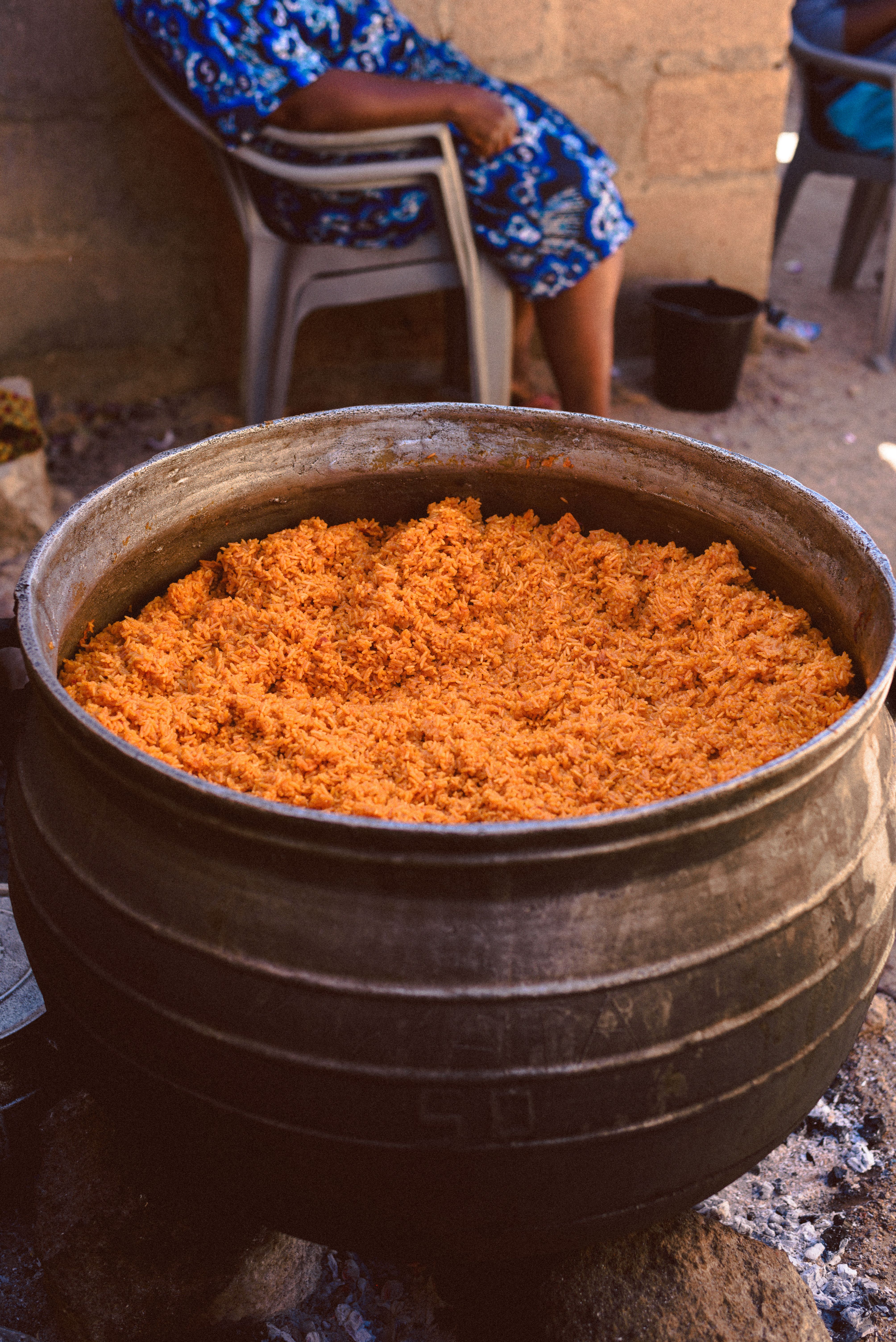
Nigerian jollof, meanwhile, is built for a crowd. It leans on parboiled long-grain rice, Golden Sella basmati is a popular choice, cooked in a base of blended tomatoes, red bell peppers and scotch bonnet chillies (locally called ata rodo), simmered in a rich meat or chicken stock. The signature “party jollof” prized at Nigerian weddings and owambe celebrations gets its distinctive smoky flavour from being cooked slowly over a wood or charcoal fire, letting the bottom layer catch slightly. That is a deliberate technique, not a mistake.
The Jollof Wars: A Modern Rivalry, Not a Historical Verdict
The cultural rivalry over jollof rice is real and ongoing, and it should be said plainly that it is a separate matter from the historical question of origin. Nigeria and Ghana have traded good-natured insults over jollof supremacy for years on social media, a rivalry known informally as the “Jollof Wars” or “Jollof Derby”. It has since grown into a proper annual event: Battle of Jollof, founded in New York City by Nigerian-American entrepreneur Arinze Emeagwali, pairs a basketball game with a jollof cook-off between restaurants representing different West African nations, and has expanded in recent years beyond its original Nigeria-versus-Ghana format to include Senegal and Liberia.
Senegal’s UNESCO recognition in December 2021 briefly reframed the argument online. Commentators noted, accurately, that Senegal’s dish had received international heritage status that neither Nigeria’s nor Ghana’s version holds. But a UNESCO listing is a statement about safeguarding a specific national dish, not a ruling on which country invented jollof rice as a category. Thieboudienne and Nigerian party jollof are related, not identical, dishes with distinct ingredients and techniques. What the Jollof Wars really capture, then, is something more interesting than a factual dispute: a shared West African food culture doing what food cultures do, arguing over ownership of something all three countries can, with justice, call partly theirs.
Who Invented Jollof Rice? The Short Answer
No single person or country invented jollof rice, and treating the question as though it has one winner misreads the history. The name and the earliest form of the dish trace to the Wolof people of the Jolof Empire in the Senegambia region, and the closest living relative of that original dish is Senegal’s thieboudienne. But the tomato-based, one-pot jollof rice familiar across West Africa today developed later and more broadly, shaped by trade routes, colonial-era agriculture, and the arrival of New World and Asian ingredients. That is why it now belongs, in slightly different forms, to Senegal, Nigeria, Ghana, the Gambia, Sierra Leone, Liberia and beyond.
Is jollof rice Nigerian or Ghanaian, then? Neither, strictly. Both countries make excellent, distinctive versions of a dish whose roots lie further west and further back than either nation’s borders. What is Nigerian is the specific smoky “party jollof” style; what is Ghanaian is the lighter, plantain-and-shito pairing; what is older than both is thieboudienne and the Wolof name itself.
Final Thoughts
None of this settles anything at a Nigerian wedding, and it probably shouldn’t. The Jollof Wars persist not because the historical record is unclear, it is reasonably clear once you go looking, but because national pride in food rarely waits for footnotes. What the record does offer is something better than a winner: a reminder that jollof rice is a genuinely shared West African inheritance, carried by Wolof rice farmers, Dyula traders, Saint-Louis fishing communities and, much later, colonial-era trade routes, before landing differently in different kitchens. Nigeria’s contribution is not inventing the dish but perfecting one particular version of it: smoky, generous and built for a party. That claim stands on its own terms, without needing to erase where the name, and the rice, first came from.