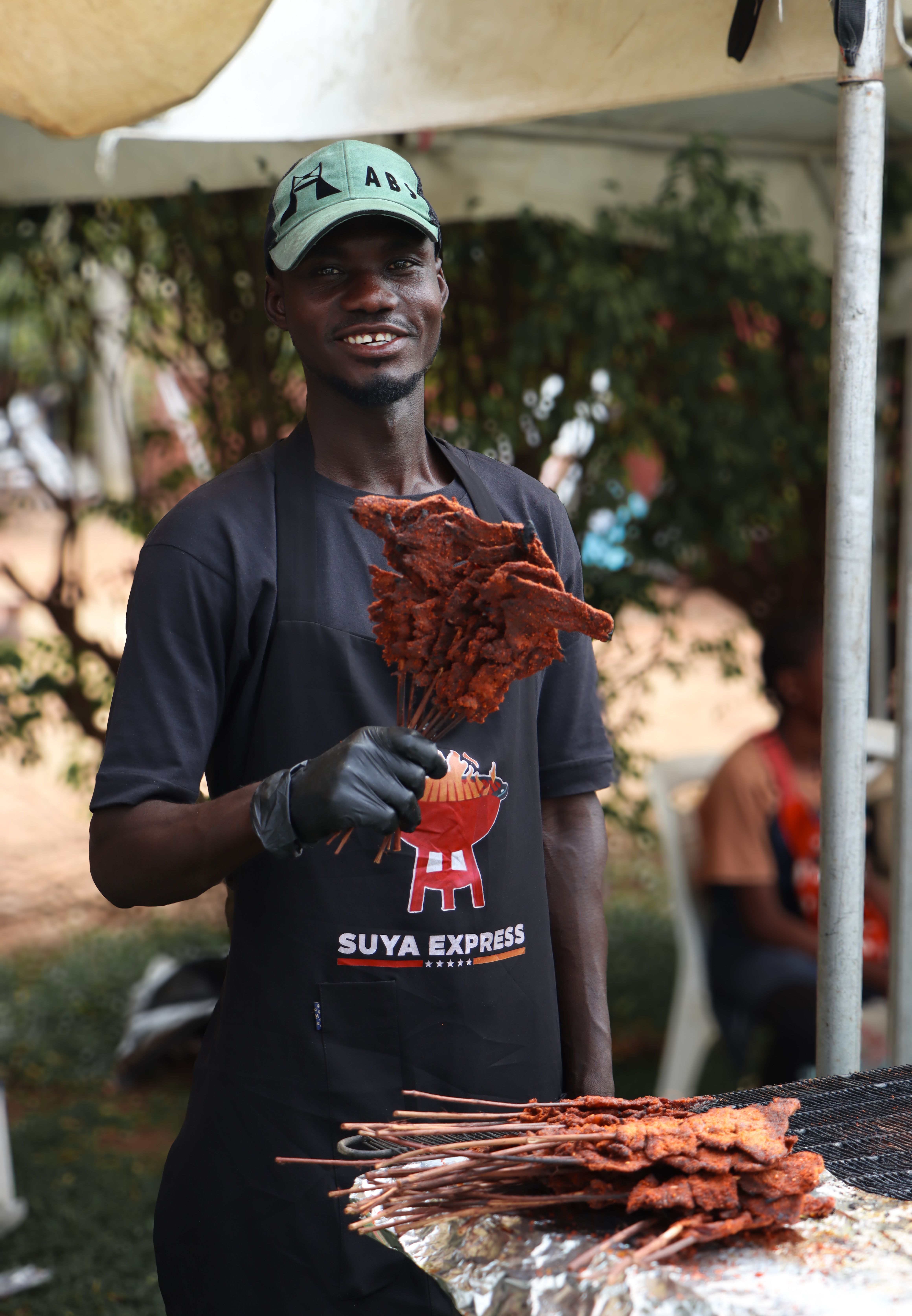
Walk through almost any Nigerian city after dark and you will smell suya before you see it: charcoal smoke, scorched pepper, and something faintly sweet from roasted groundnuts, drifting off a low grill set up on a street corner. Long queues form. Motorbikes idle nearby while their riders wait for a wrap of meat dusted in a fiery red spice mix. It hardly matters whether you are in Kano, Lagos, Port Harcourt or Enugu, the ritual looks the same. Suya has become one of the very few things that unites Nigerians across ethnic lines, and that is worth pausing on, because the dish did not start out belonging to everyone. It began with the Hausa people of Northern Nigeria, whose butchering, trading and spice-blending traditions turned a simple grilled meat into something the rest of the country would eventually claim as its own. This is the story of how it travelled.
What Suya Actually Is
At its simplest, suya is thin-sliced meat, traditionally beef, though ram, goat and chicken are common too, threaded onto skewers and grilled quickly over an open flame. What sets it apart from any other kebab is the coating: a dry, reddish-brown spice mix called yaji, built around ground roasted peanuts (or peanut cake, known as kuli-kuli), dried chilli and cayenne pepper, ginger, garlic and dried onion, with salt worked in to taste. There is no single fixed recipe. Yaji varies from one seller’s blend to the next, much like curry powder varies across South Asian kitchens, and a Hausa vendor guards his particular mix the way a chef guards a signature sauce. The meat is usually oiled before it hits the grill, then dusted again with more yaji once cooked, and handed over with sliced onion and tomato, wrapped in old newspaper or brown paper.
The dish also goes by another name in the north: tsire. Both suya and tsire describe the same grilled, spiced meat, and the person who sells it is called a mai suya or mai tsire, “mai” being the Hausa word for “seller of” or “owner of”. That naming convention tells you something: suya was never conceived as a meal to cook at home and eat quietly. It was, from the outset, something sold, and something eaten in public.
Born in the Hausa North
Suya’s roots sit with the Hausa people of Northern Nigeria, a region whose history is built on long-distance trade. Hausa merchants and herders moved cattle, kola nuts, leather goods and grain across enormous distances for centuries, and their major towns, Kano chief among them, grew into some of West Africa’s great trading centres. Meat, and the skill of preparing it well, sat close to the centre of that world. Precisely when suya as we know it today first appeared on a grill is not something the historical record pins down; several accounts describe its exact origins as unclear even while agreeing on where it came from. What is well established is that suya grew out of Hausa butchering and grilling traditions, helped along by the ready availability of groundnuts as a regional crop, and by a culture of urban markets where food was sold to travellers and townspeople rather than cooked solely at home.
The Fulani, close neighbours and frequent partners of the Hausa in cattle-rearing across the north, get some of the credit too in several accounts, given how entangled the two groups’ pastoral and trading economies became over time. Either way, suya was a northern, Hausa-led invention long before it was a national one.
The Mai Suya and the Evening Ritual
For most of its history, suya has been prepared and sold almost exclusively by Hausa men, and that has not changed much even as the dish has spread far beyond Hausa communities. A mai suya typically sets up his grill, often a simple metal frame over hot coals, in the same spot every evening, and regular customers come to know him by name. This is not a lunchtime food. Suya belongs to the evening and the night: sold as the sun goes down, still busy well past midnight, particularly at weekends.
That timing is not incidental. Suya spots have become genuine gathering places, somewhere between a snack stand and a social institution. Friends meet there after work. Groups heading out for the evening stop to eat before carrying on. People leaving a party at two in the morning know exactly where to find a mai suya still grilling. In a country where formal restaurant dining is not always affordable or accessible, the suya spot offers something more democratic: a shared, unpretentious space where a company director and a taxi driver might easily be standing in the same queue.
From Kano to Lagos: A Truly National Dish
What makes suya’s story distinctive is how completely it crossed ethnic lines. Nigeria is a country of enormous cultural variety, and food usually stays tied to the region or people that produced it, jollof rice carries Yoruba and Senegambian associations, amala belongs to the Yoruba southwest, edikang ikong is unmistakably Efik and Ibibio. Suya did something rarer. Nigerian food writers have described it as a genuine unifying factor: a dish sold on street corners in every major city, prepared largely by Hausa vendors who set up business far from their home region, but eaten by everyone regardless of where their own family comes from.
Part of that is simple economics. Suya is affordable, portable and quick, which made it easy to adopt. Part of it is that a mai suya arriving in a new city brings his craft with him rather than needing ingredients that only exist up north, groundnuts, chilli and onions are available everywhere. Whatever the precise mix of reasons, suya’s reach today has little to do with where a customer’s own ethnic roots lie. It is simply what people eat on a Nigerian street after dark, in Lagos as much as in Kano.
Crossing Borders: Suya in the Diaspora
Suya has followed Nigerians abroad, too. In cities with sizeable Nigerian communities, London especially, but also across the United States and Canada, suya spots and Nigerian restaurants serving it have become gathering points much as they are at home. In Peckham, south London, the restaurateur Kolawole Ajayi has built a business around suya and other Nigerian dishes, describing the area as home to “a very strong community” where food offers a direct route back to a sense of cultural roots. He is careful to note that while suya “originated with the Hausa and Fulani people,” it has since become something claimed and enjoyed across African communities more broadly, with cousins of the dish appearing under different names elsewhere on the continent.
For the diaspora, a plate of suya does a particular kind of work. It is instantly recognisable, easy to share with non-Nigerian friends as an introduction to the country’s food, and specific enough in its smoke and spice to summon a very precise memory for anyone who grew up with it.
FAQs
What is suya made of? Thin strips of meat, usually beef, coated in yaji, a dry spice blend of ground roasted peanuts, chilli, ginger, garlic, dried onion and salt, then grilled over charcoal and served with sliced onion and tomato.
Where does suya come from? Northern Nigeria, among the Hausa people, whose long tradition of cattle trading, butchery and spice-blending produced the dish. Fulani herding culture, closely linked to Hausa communities in the north, is often credited alongside it.
Is suya only eaten in the north? No. It has spread nationwide and is now sold in every major Nigerian city, prepared largely by Hausa vendors known as mai suya, and eaten across every ethnic group in the country.
Why It Still Matters
Suya’s journey from a Hausa trading town to a Lagos beachfront to a London high street says something about how food moves in ways that borders and census categories rarely capture. Nigeria’s ethnic diversity is real, and it shapes daily life, from language to music to, most of the time, what people eat. Suya is one of the exceptions. It slipped past those lines because it was portable and affordable, and because it was good enough that nobody much cared where it had come from.
I think that is the real lesson in a plate of suya: culture does not always spread through conquest or policy. Sometimes it spreads because a man sets up a grill on the right street corner, at the right hour, and word gets round. Today, decades on and thousands of kilometres apart, that same evening ritual, the smoke, the queue, the wrap of paper, plays out largely unchanged, from Kano to Lagos to Peckham.