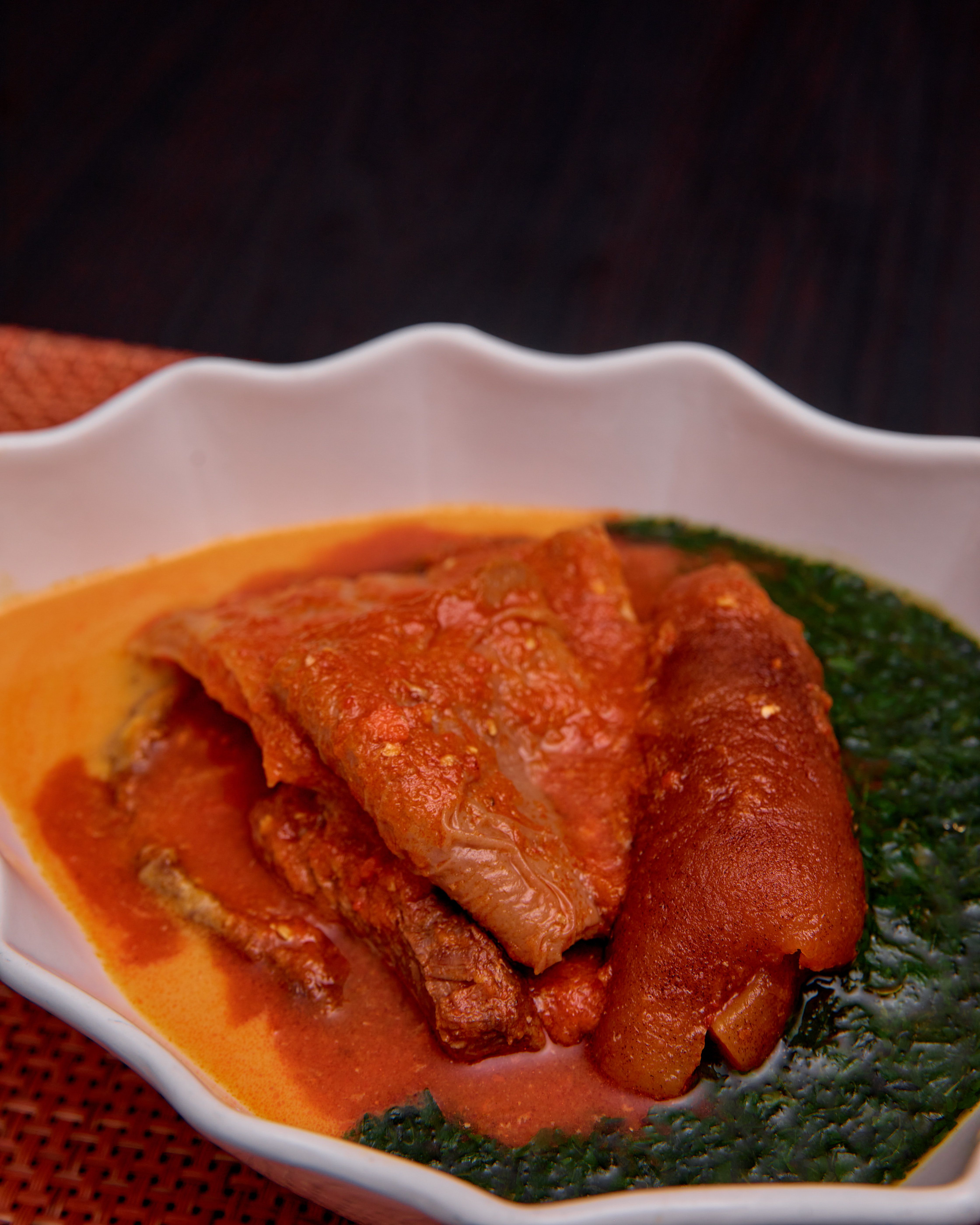
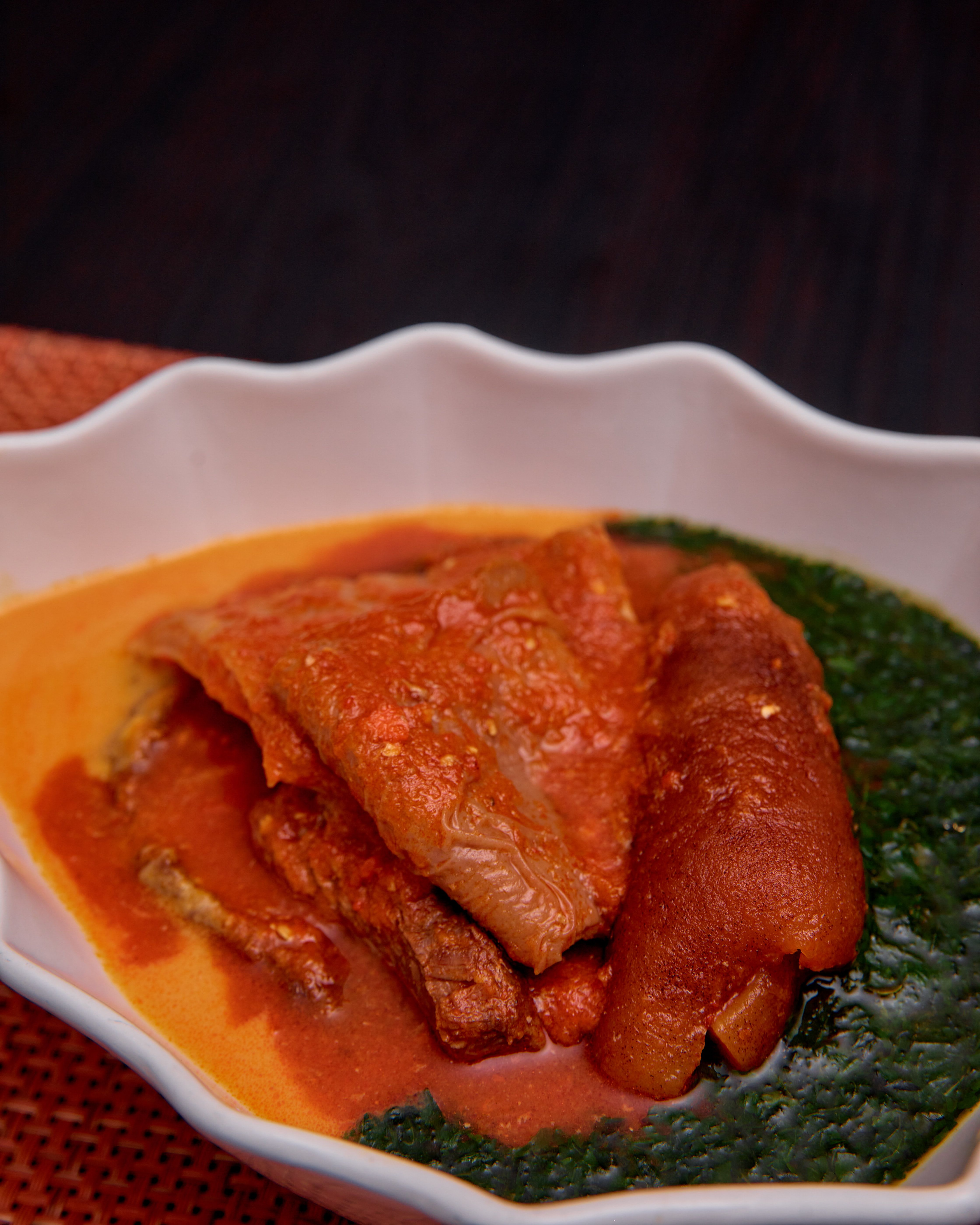
Edikang Ikong: Calabar’s Most Nutritious Soup
Walk into a Calabar kitchen on a Sunday and you will likely find a pot of edikang ikong steaming on the fire, its surface a deep, glossy green that looks more like a vegetable patch than a soup. This is the signature dish of the Efik, Ibibio and Annang peoples of Cross River and Akwa Ibom States, in Nigeria’s Niger Delta region. Few other Nigerian soups carry the same reputation. It is widely regarded as one of the country’s most nutrient-dense traditional dishes, built almost entirely from leafy greens, and it has a long history as a marker of wealth and celebration in Efik-Ibibio society.
To understand edikang ikong properly, it helps to know both what it is made of and why it came to matter so much in this particular corner of Nigeria. It is a dish shaped by the trading wealth of Old Calabar, the ceremonial customs of Efik society, and the genuine nutritional properties of the vegetables at its heart. The companion recipe card that follows will walk through method and measurements; this piece is concerned with the soup’s meaning.
What Is Edikang Ikong Made Of?
At its foundation, edikang ikong is a vegetable soup built from two leafy greens: waterleaf (Talinum triangulare, a soft, moisture-rich green also eaten across West Africa, South Asia and Brazil) and ugu, or fluted pumpkin leaves (Telfairia occidentalis, a vine indigenous to southern Nigeria). The two are shredded and cooked down together in palm oil, alongside a generous mix of protein. Assorted meats, dried fish, stockfish, crayfish, periwinkle and cow tripe (shaki) are all traditional additions, seasoned simply with pepper, onion and salt.
What sets edikang ikong apart from other Nigerian soups is proportion. Many soups treat vegetables as a background note to a starch or protein. Edikang ikong inverts that relationship, so vegetables become the substance of the dish rather than the garnish. It is typically eaten with a swallow such as pounded yam, garri (eba) or semolina, used to scoop rather than dilute the soup.
It is worth distinguishing edikang ikong from afang soup, its close cousin from the same region. Afang uses a different, tougher leaf (afang or okazi leaf, not to be confused with waterleaf) and has its own texture and flavour. The two are often mentioned together because they share an ethnic homeland and a similar protein-and-vegetable structure. They remain, all the same, two different dishes.
A Dish Born of Old Calabar
The Efik settled at Creek Town, near present-day Calabar, in the early seventeenth century. The city they built, known in the Efik language as Akwa Akpa, grew into one of the most important ports on the West African coast. From the sixteenth century onward it exported palm oil. From the early eighteenth century it also became a major point of departure in the transatlantic slave trade, with tens of thousands of enslaved Africans forced through the port in the mid-1700s alone. By the nineteenth century, following the 1841 agreement between Efik kings Eyo Honesty II and Eyamba V to end the export of enslaved people, Calabar’s trading houses shifted toward palm oil and other legitimate commerce. The city became a centre of missionary education too, home to Nigeria’s first secondary school and first hospital.
This was a wealthy, cosmopolitan trading society, and Efik social life reflected it. Efik communities were organised into “Houses” led by chosen leaders, and the Ekpe society, the paramount authority, restricted its higher ranks to the genuinely wealthy. Livestock such as the native Efik cow (enañ Efịk) was kept for ceremonial occasions rather than everyday eating. A soup that demanded large quantities of imported and locally sourced protein alongside vast amounts of vegetables was never going to be an everyday dish for the ordinary household. It was, and in many ways still is, a soup that announces means.
A Soup That Signals Status
Edikang ikong’s association with wealth is a direct consequence of what the dish actually requires, not folklore dressed up as fact. A proper pot uses vegetables in bulk, enough waterleaf and fluted pumpkin leaves to fill several bowls before cooking, since leafy greens reduce dramatically once wilted. It also calls for multiple varieties of meat and fish rather than a single protein. In a society where meat and imported stockfish were markers of prosperity, and vegetables themselves had to be bought in quantity at market rather than grown in a small home plot, a full pot of edikang ikong represented a genuine outlay.
That is why the soup has long been associated with celebration rather than routine weeknight cooking: weddings, chieftaincy ceremonies, the entertaining of important visitors, festive gatherings among the Efik and Ibibio. Several Nigerian outlets, including Pulse Nigeria and The Guardian Nigeria, have described it as a dish “eaten mostly by rich people.” That is shorthand for its cost and abundance rather than any formal restriction. Anyone can cook it. Not everyone could once afford to cook it well, and its appearance at a table still signals generosity and effort on the part of the host.
This status has travelled with the dish as Efik and Ibibio families have moved beyond Cross River and Akwa Ibom, to Lagos, Abuja and diaspora kitchens further afield, in London, Houston, Toronto. At a Nigerian gathering abroad, edikang ikong still carries a note of occasion. It is the pot that says a host has taken real trouble.
The Nutrition Behind the Reputation
The claim that edikang ikong is unusually nutritious holds up reasonably well against what is known about its two core ingredients, and it is not simply marketing language. Fluted pumpkin (Telfairia occidentalis) shoots and leaves are recognised in the botanical and food-science literature for their high potassium and iron content, along with antioxidant compounds linked to hepatoprotective and antimicrobial effects. Long before laboratory analysis confirmed any of this, the plant was already used in traditional medicine across southern Nigeria as a blood tonic for the weak and unwell, and as a folk remedy for anaemia, convulsion and malaria. Those uses align closely with a leaf now known to be iron-rich.
Waterleaf (Talinum triangulare), the soup’s other principal green, contributes vitamins A and C along with iron and calcium. It is also relatively high in oxalic acid, worth noting for anyone managing kidney stones, gout or rheumatoid arthritis. Add the crayfish, periwinkle, dried fish and assorted meats typically found in the pot, and edikang ikong delivers iron, protein, vitamin A and antioxidants in a single dish. That is a genuinely unusual nutritional profile for a soup built mainly from leaves rather than starch or grain.
None of this makes the soup a medicine. The sourcing matters here: traditional use as a blood tonic is a documented cultural fact, not a clinical guarantee. What can be said with confidence is that a dish built almost entirely from two nutrient-rich leafy vegetables, plus varied protein, is a considerably more nutrient-dense way to eat than many alternatives. That is precisely why the “most nutritious soup in Nigeria” label has followed edikang ikong for so long.
Is Edikang Ikong Healthy?
Given its composition, mostly leafy vegetables cooked relatively briefly, combined with fish and lean cuts of meat, edikang ikong compares favourably with soups built around starch-thickened bases or very high oil content. The main caution is the same one that applies to most Nigerian soups: palm oil and the volume of protein used can make a single serving calorie-dense, so portion and the choice of swallow matter more than the soup itself.
Final Thoughts
Edikang ikong tells you something true about the place it comes from. Old Calabar built its wealth on trade, and its most celebrated dish still carries that history in every spoonful, a pot that requires abundance to make properly and has long signalled hospitality whenever it is served. The same vegetables responsible for its reputation as a prestige dish also happen to be genuinely rich in iron, vitamin A and antioxidants. That is less a coincidence than a reminder: Efik and Ibibio cooks were working with excellent ingredients long before nutrition science caught up to explain why. It remains, today, a plate of good sense and a plate of good occasion at once.
Sources:
- Encyclopaedia Britannica, “Efik” (people of Nigeria)
- Encyclopaedia Britannica, “Calabar” (Cross River State, Nigeria)
- Akoroda, M.O. (1990). “Ethnobotany of Telfairia occidentalis (Cucurbitaceae) among Igbos of Nigeria.” Economic Botany, 44(1), 29–39.
- Okoli, B.E. & Mgbeogu, C.M. (1983). “Fluted Pumpkin, Telfairia occidentalis: West African Vegetable Crop.” Economic Botany, 37(2), 145–149.
- General reference cross-checks: Wikipedia entries on Edikang ikong, Efik people, Telfairia occidentalis, Talinum fruticosum, Afang soup and Calabar (used for corroboration of widely-documented facts, not as sole sources for contested claims)
- TasteAtlas, “Edikaikong” entry