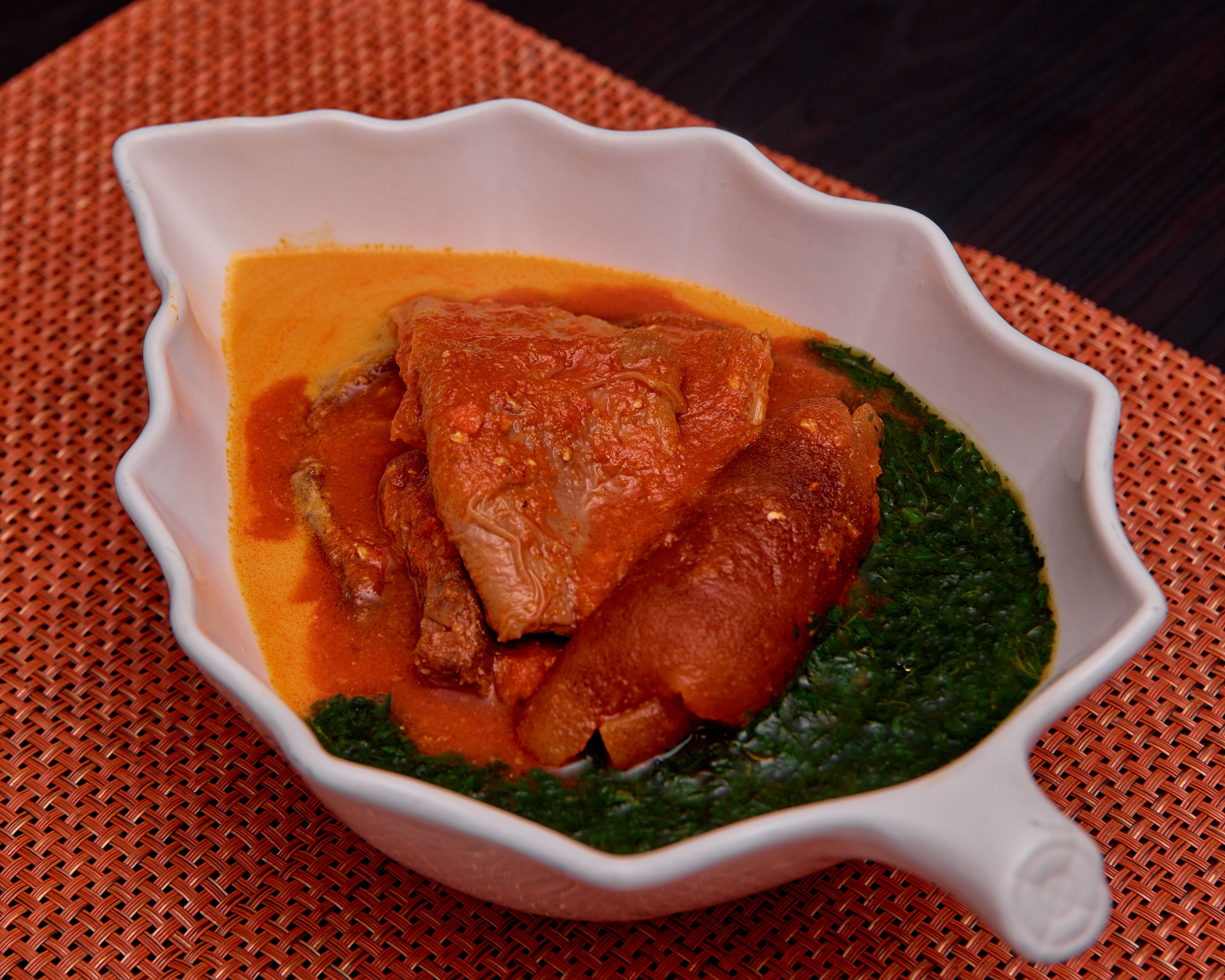
There is a particular kind of quiet that settles over a Yoruba household on a Sunday afternoon, once church has emptied out and the kitchen has taken over. Somewhere in that quiet, someone is stirring a thick, dark paste in a pot of boiling water, working it the way you would work dough, until it turns smooth and elastic. That is amala, and where it appears, two soups are rarely far behind: ewedu, a slippery, bright green soup made from jute leaves, and gbegiri, a thick, earthy soup made from mashed brown beans. Together, they form one of the most recognisable meals to come out of south-western Nigeria, eaten by Yoruba families from Lagos to Ibadan and now, increasingly, in diaspora kitchens from Peckham to Houston.
This is the story behind the plate, not a recipe: what each dish is, where it comes from, why the three so often turn up together, and why so many Yoruba families still treat this particular combination as Sunday food.
What Is Amala Made Of?
Amala is a “swallow”, in Yoruba, okele, the broad category of smooth, dense starches eaten across much of southern Nigeria as an alternative to rice or bread. Rather than being chewed, a swallow is pinched off, rolled lightly between the fingers, and used to scoop up soup, sliding down with barely any resistance. Amala’s particular identity comes from what it’s made of: dried, ground yam.
Fresh yam, when peeled, sliced and pounded, gives the pale, springy dish known as pounded yam. Amala takes a different route. The yam is peeled, sliced and left to dry in the sun before being ground into flour, a preservation method that predates refrigeration by centuries, letting families store yam for lean months. That drying process is also what gives amala its distinctive dark brown colour, quite unlike the near-white of pounded yam made from the same crop.
There are two other common versions. Amala láfún uses dried cassava flour instead of yam, producing a paler, slightly tangier swallow. A third, lighter version is made from unripe plantain flour, valued today partly because it carries less carbohydrate than the yam original. Which version a household reaches for often comes down to regional habit as much as taste: in Ogbomoso, a town in Oyo State, the yam-flour version is such a point of civic pride that it features in the town’s own popular nickname, a mark that sets local amala apart from the cassava-based versions eaten elsewhere in Yorubaland.
Ewedu: The Soup That Draws
Ewedu takes its name, and its character, from a single leafy vegetable: Corchorus olitorius, known in English as jute mallow or Jew’s mallow, and grown widely across West Africa. Once boiled and blended, the leaves release a natural thickening quality that gives ewedu its defining texture, somewhere between silky and stringy, a “draw” soup in the same family as okra soup, where the food quite literally trails in fine threads from spoon to bowl.
The soup is typically built with very few additions: a little potash to intensify the drawing texture, locust beans (iru) for a deep, fermented savouriness, and ground crayfish for salt and depth. It is a soup that rewards restraint. Its job, on the plate, is largely textural and aromatic, a bright, slightly bitter counterpoint to the milder gbegiri and the neutral amala.
Nutritionally, jute leaves have long been prized well beyond Yoruba kitchens; the same plant, under different names, turns up in Middle Eastern and East African cooking as mulukhiyah, one of several soups worldwide built around a leafy vegetable’s natural thickening power. In Yoruba households, though, ewedu rarely stands alone. It is almost always paired, either served alongside gbegiri, or, more often, mixed directly with it.
Gbegiri: The Bean Soup Underneath
Gbegiri is quieter than ewedu, both in colour and in flavour, but it does much of the meal’s heavy lifting. It is made from honey beans, sometimes called brown beans, that are soaked, peeled and mashed into a smooth, velvety paste. That paste is then simmered with palm oil, ground crayfish, locust beans and pepper until it thickens into a soup with a mild, faintly nutty depth.
The peeling step matters. Removing the bean skins before cooking is what gives gbegiri its characteristic smoothness, setting it apart from the coarser bean soups and porridges found elsewhere in Nigeria, and from the fried bean cake, akara, that shares the same core ingredient in a very different form. Where ewedu supplies brightness and bite, gbegiri supplies body, the soup most likely to make the meal feel substantial rather than merely flavourful.
Gbegiri’s cultural weight is felt most strongly around Ibadan and its surrounding towns. In Ogbomoso, the dish is celebrated with its own annual “Amala and Gbegiri Day”, organised by a community group to mark local heritage and bring together members of the town’s diaspora, a reminder that a soup can carry as much civic identity as any monument.
Abula: Why the Three Are Served Together
When amala, ewedu and gbegiri appear on the same plate, the combination has its own name: abula. The word describes not just the pairing but a specific method of serving it, a small well is pressed into the amala, and the two soups are poured in together and gently mixed, rather than kept in separate bowls. Eaten this way, each spoonful carries a little of both soups’ character: ewedu’s brightness cut with gbegiri’s depth, wrapped around a mouthful of amala.
Abula is closely associated with Ibadan and the wider Oyo State area, where it is considered something of a local speciality rather than an everyday throwaway meal. It takes real time to prepare three dishes properly rather than one, and that effort is part of the point. Across Yoruba communities, abula tends to appear at moments that call for a bit more generosity than an ordinary weekday dinner: weddings, naming ceremonies, political gatherings, and, for many households, Sunday.
The Yoruba Sunday Table
Sunday occupies a particular place in the rhythm of many Yoruba households, especially Christian ones, where church in the morning is often followed by the week’s most elaborate meal in the afternoon. It is a pattern of timing as much as tradition: Sunday is usually the one day without work or school pressing on the clock, which makes it the natural home for a meal that takes longer to prepare and is meant to be eaten slowly, in company, rather than snatched between errands.
Food carries more than nutrition in this context. In a 2017 study, the agricultural researchers Jude Obidiegwu and Emmanuel Akpabio traced how deeply yam, the crop at the very root of amala, is woven into social standing, religious practice and gender roles across Yoruba and neighbouring communities, describing it as central to the “social, economic, religious and cultural fabric” of the societies that grow it. A plate of amala carries a little of that inherited weight too, even when nobody at the table is thinking about it directly.
For diaspora families, the Sunday abula table often becomes something sharper still: a weekly, deliberate act of continuity, recreated in kitchens far from Ibadan or Ogbomoso, sometimes with yam flour carried back from a trip home or bought from a West African grocer down the road.
FAQs
What is amala made of?
Most commonly, dried yam that has been sliced, sun-dried and ground into flour, then cooked into a smooth paste with boiling water. Cassava flour (láfún) and unripe plantain flour are the two other common versions.
What do Yoruba people eat on Sunday?
There is no single fixed menu, but a full, soup-based meal, often amala, ewedu and gbegiri, or a similarly substantial swallow-and-soup combination, is a common choice for the week’s main family meal, typically eaten after church.
Is amala the same as pounded yam?
No. Both come from yam, but pounded yam is made by pounding the fresh, boiled tuber, giving a pale, springy result, while amala is made from dried yam flour, giving a darker, denser swallow.
A Meal Worth the Effort
None of these three dishes is quick. Yam has to be dried and ground, or bought as flour, before it ever meets boiling water; jute leaves have to be picked over and blended; beans have to be soaked and peeled by hand. That effort is, in a sense, the whole point. A meal that takes the better part of an afternoon to prepare properly is not something most households make on a Tuesday, which is exactly why it has settled so comfortably into Sunday’s slower rhythm.
What strikes me most about amala, ewedu and gbegiri is how well the three balance one another: a neutral, absorbent base; a bright, textured soup; and a deep, savoury one beneath it. It is a combination refined by repetition, town by town, kitchen by kitchen, until it became shorthand for home. Wherever it is eaten now, in Ibadan, in Lagos, or in a diaspora kitchen thousands of miles from either, abula still does the same quiet work it always has: turning an ordinary Sunday into something worth sitting down for.