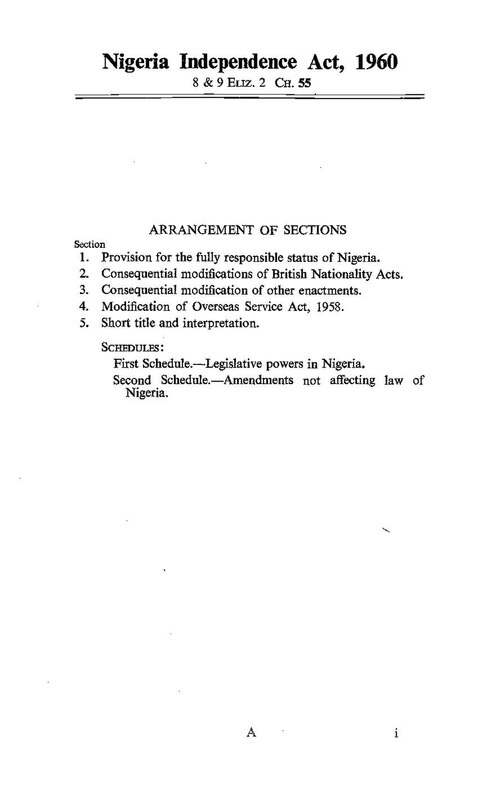
The Nigeria Independence Bill was given its second reading in the House of Commons on a Friday morning. It began at ten past eleven. The benches were thin enough that several speakers stopped mid-debate to complain about it.
That is where I want to start, because it tells you more than any of the speeches. Britain was handing back the most populous country in Africa, and it scheduled the debate for the graveyard slot. The Hansard record of 15 July 1960 runs to just over fifty columns. Nobody voted against. What was said in those columns – and what was carefully not said – is one of the more revealing documents about how Britain understood its own empire at the moment of letting it go.
The Bill itself
Iain Macleod, Secretary of State for the Colonies, moved the second reading. The Act received Royal Assent on 29 July 1960, one of fifty-five that day, and Nigeria became independent on 1 October.
Macleod read the operative words of the first clause to the House: no Act of the United Kingdom Parliament passed after the appointed day “shall extend … to Nigeria,” and the British Government “shall have no responsibility for the government of Nigeria or any part thereof.” Then he added, drily: “Whatever people may say about the complexities of Parliamentary drafts-menship, that is clear enough.”
One detail deserves more attention than it got at the time. The constitution of independent Nigeria was not in the Bill. Macleod told the House it “is not, of course, set out in the Bill. It will be contained in an Order in Council to be made fairly soon, probably in September, after the Bill has passed into law.” Parliament voted to make Nigeria independent without the constitutional text in front of it.
The self-congratulation
The dominant register of the debate is pride, and it is worth quoting exactly, because the pride is doing real work.
Macleod’s central claim was that none of this was Britain’s design: “In my view, this is all the better since it has not been imposed in any way, and I frankly tell the House what I am putting before it today is primarily a work of Nigerians themselves.” He also offered the House a structural explanation for the shape of the new state – that Nigeria “is, of course, extraordinarily diverse in race, religion and in social and economic development,” and therefore “it is not in the least surprising that the political development it has chosen is that of a Federation in three regions, with each region self-governing in its own concerns.”
Arthur Creech Jones, Labour MP for Wakefield and himself Colonial Secretary from 1946 to 1950, put the imperial case more openly than anyone else in the chamber. He described the whole project as transformation rather than retreat: “Too many of my critics were completely oblivious to the fact that what we were trying to do was to transform an Empire into a Commonwealth.” And he allowed himself the comparison that was clearly in several minds: “perhaps we could argue that the British method – the British system of administration and policy – has some superior quality above the systems exercised by other nations in the administration of their territories in the African Continent.”
The unnamed comparison is the Congo, which had collapsed into crisis that same month. It shadows the entire debate.
The doubts, and where they came from
What makes the record valuable is that the self-congratulation does not go unchallenged – and the challenges come from unexpected directions.
Creech Jones undercut himself within the same speech, and it is the most honest passage in the debate: “I am not arguing that on looking back on our own record we need be too complacent about it. I remember that from time to time I have made my protest in this House against the degree of human exploitation which one has discovered in some of our territories. I have protested from time to time against the seizure of native land which ought to remain with the people. I have complained against forced labour which was practised even in Nigeria in the period of the war.”
A former Colonial Secretary, eleven weeks before independence, conceding forced labour in Nigeria on the floor of the Commons. It is said once and not returned to.
Fenner Brockway, Labour MP for Eton and Slough and a long-standing anti-colonial campaigner, raised the thing that nobody else did: “My one regret about this Bill is that the women of the Northern Region are not enfranchised. In the East, yes; in the West, yes; in the North, not yet, because they are a Muslim country.” He also warned the House against its own tone – “we must not be too self-righteous in this respect” – and pointed out that Nigeria’s smoother path owed a good deal to the simple fact that it “has not had large immigrant settler communities from Europe and from Asia.” Not British virtue. Demography.
The most sceptical speech came from the Conservative benches. Sir Kenneth Pickthorn, MP for Carlton, was the one man willing to suggest that withdrawal carried its own risks: “the risk of doing harm may well be greater – and, certainly, the consciousness of responsibility should be greater – at the moment of cessation of protection and sovereignty than it was at any earlier moment.” He went further, reminding a House that had spent the morning treating democracy as a British export that “democracy is not traditional in this country as, I think, almost every other speaker has assumed. It is a very modern, new thing in this country even.”
Pickthorn was also the one who said the quiet thing about the attendance: “If we were discussing stag hunting, or Members’ pay… Or Sunday observance, I dare say the benches would have been crowded.”
What was not said
Two absences stand out.
The first is the Anglo-Nigerian defence agreement. Macleod confirmed to the House that such an agreement had been reached and would come into force after independence – but it was not published at the time of the vote. It became bitterly controversial in Nigeria and was abrogated in 1962. Members approved independence without seeing the military terms attached to it.
The second is what happens to a three-region federation in which one region is larger than the other two together. Creech Jones came closest, naming “the great problem of how to weld into unity for great national purposes three great divisions of peoples with different traditions and different languages and religions,” and cautioning against “too slavish a regard to the Westminster model.” He also noted that Nigeria was inheriting “an administrative framework which, perhaps, is not as adequate and experienced as we would wish.” The warning is there in the record. It simply goes nowhere.
Did anyone vote against Nigerian independence?
No. There was no division in either House. The Lords gave the Bill its second reading on 28 July, moved by the Earl of Home – who had become Foreign Secretary the previous day, giving up the leadership of the House of Lords to take the job.
That unanimity is not quite the endorsement it appears. Independence had already been promised two years earlier: in November 1958, Alan Lennox-Boyd told the Commons that if the newly elected Nigerian legislature asked for independence in early 1960, the Government would agree and legislate for 1 October 1960. By July 1960 the decision was long made. The debate was a formality, which is precisely why it was given a Friday morning and why so few members came.
Reading it now
What strikes me most is the gap between the tone and the content. The tone is valedictory – a job well done, an empire gracefully converted into a Commonwealth. The content, if you read the same fifty columns for what is actually admitted, includes forced labour in wartime Nigeria, an unenfranchised female population in the largest region, an unpublished defence agreement, a constitution nobody had seen, and an administrative service that a former Colonial Secretary openly admitted was not up to the job.
All of it is on the record. It was said aloud, in the chamber, by people who knew what they were talking about. It simply arrived in a room too empty to argue with.
Nigeria became independent eleven weeks later, with Elizabeth II as Queen of Nigeria – a constitutional arrangement that lasted until the republic of 1963. But the terms had been set that Friday morning, in front of almost nobody.
Sources
- HC Deb 15 July 1960, vol 626, cc1793–1846, “Nigeria Independence Bill” (Second Reading), House of Commons. UK Parliament Historic Hansard.
- HC Deb 29 July 1960, vol 627, cc2039–40, Royal Assent. UK Parliament Historic Hansard.
- HL Deb 28 July 1960, vol 225, cc903–918, “Nigeria Independence Bill,” House of Lords. UK Parliament Historic Hansard.
- HC Deb 4 November 1958, vol 594, cc741–742, “Constitutional Conference.” UK Parliament Historic Hansard.
- Nigeria Independence Act 1960 (8 & 9 Eliz. 2 c. 55), legislation.gov.uk.
- Prosser Gifford and Wm. Roger Louis, Decolonization and African Independence: The Transfers of Power, 1960–1980 (Yale University Press).
All quotations are taken from the Hansard record as printed. Commons quotations are from the continuous text of the 15 July 1960 debate; the Lords proceedings of 28 July are cited for the fact of the second reading rather than quoted.