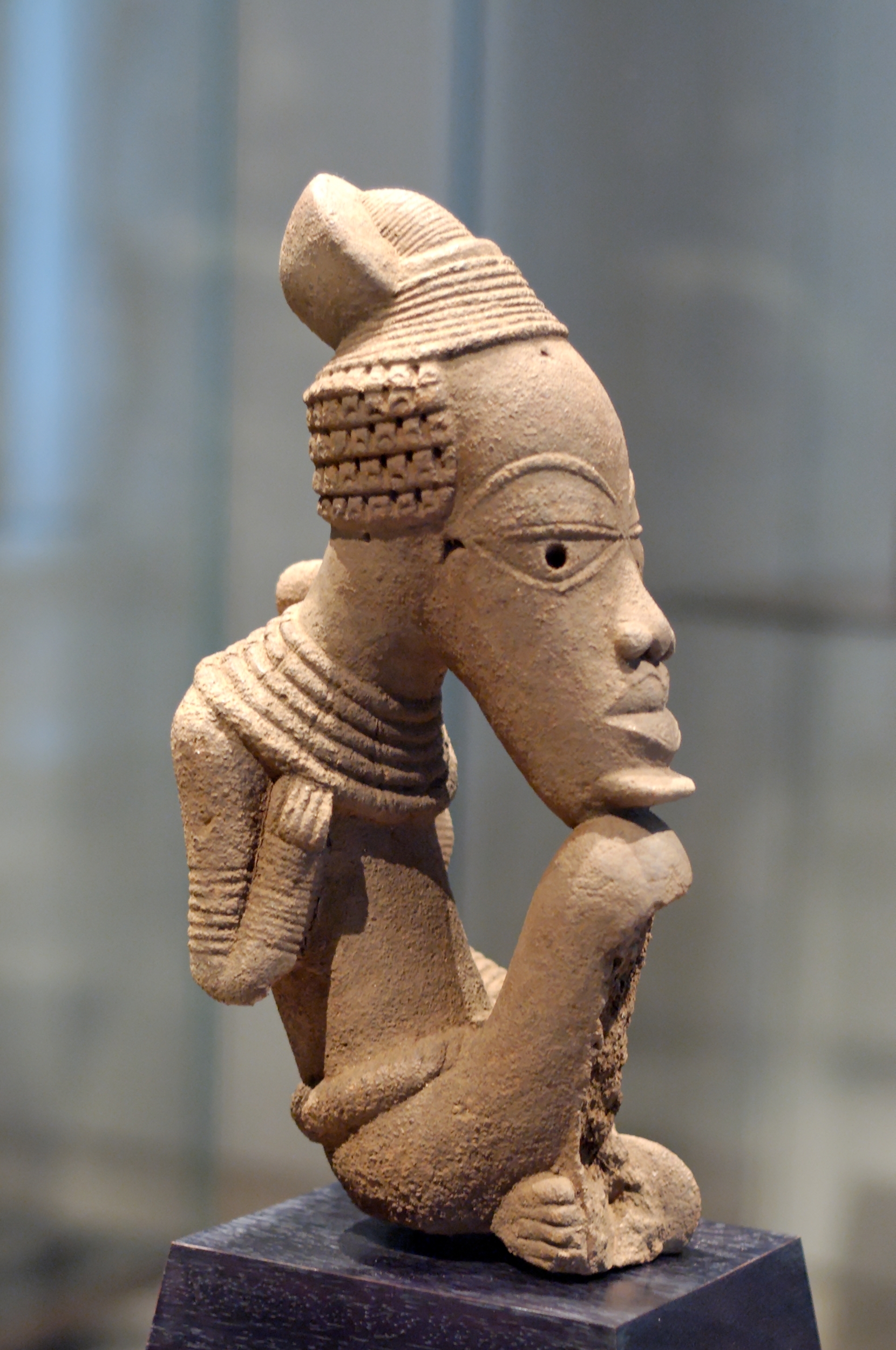
For almost a thousand years, someone on Nigeria’s Jos Plateau was making faces out of clay: heads tipped back, eyes pierced into elegant triangles, hair plaited into patterns so precise they still read as fashion rather than folklore. We do not know what these people called themselves. We do not know their language, their king, or the name of a single sculptor. What survives is the sculpture itself, and it is old enough to predate the pyramids of Meroë and the Roman Republic’s most famous years. Discovered by accident in a tin mine in 1928, the Nok terracottas are the oldest known figurative sculptures from sub-Saharan Africa, and how they were found is almost as striking as what they show. This is that story: how the figures came to light, how old they really are, what they tell us, and why so many are still disappearing today.
An Accidental Discovery on the Jos Plateau
The Nok culture takes its name from an ordinary village on Nigeria’s Jos Plateau, in what is now Kaduna State, where nobody was looking for archaeology at all. In 1928, workers tin-mining the area kept turning up small clay heads in the spoil. According to the mine manager, Lieutenant-Colonel John Dent Young, who sent the fragments on to the museum at Jos, one of the earliest recognised pieces was a small terracotta monkey’s head, unearthed from beneath several metres of sand and gravel that mining operations were stripping away. Nobody at the time understood what they had found.
It took decades, and the work of the British archaeologist Bernard Fagg, to establish that these fragments belonged to a single, coherent artistic tradition. Fagg began collecting and cataloguing pieces through the 1940s and 1950s, eventually excavating a controlled site at Taruga that produced both terracotta figures and iron-smelting slag in the same layers, radiocarbon-dated to several centuries BC. By the time his fieldwork was done, he had assembled close to two hundred terracotta pieces, drawn from purchases as much as excavation, since so much material had already been scattered by mining before archaeologists ever arrived. That mixed origin, part scientific dig, part rescued mining debris, has shaped Nok archaeology ever since: a great deal of what we know comes from objects whose exact findspot was never recorded.
Dating a Civilisation Without Writing
Because the Nok left no writing, everything we know about when they lived comes from the ground itself: radiocarbon dating of charred plant remains and charcoal, and thermoluminescence dating of the fired clay figures. The most thorough study of this evidence, published by the archaeologist Gabriele Franke in the Journal of African Archaeology in 2016, drew on 174 radiocarbon dates and 27 luminescence measurements collected from 69 excavated sites over almost a decade of fieldwork. It sets out three phases: an early settlement period from around 1500 to 900 BC, when farmers were growing pearl millet on the plateau but had not yet begun making figurines in any confirmed context; a middle period from around 900 to 400 BC, when both the terracotta tradition and iron production were firmly established and site numbers rose sharply; and a later, declining phase running to around the turn of the era.
That timeline places the true flourishing of Nok terracotta sculpture a little earlier than the range most often quoted in general references, which cite roughly 500 BC to AD 200, a figure drawn from earlier rounds of thermoluminescence testing on the sculptures themselves. Both estimates agree on the point that matters most: figures were already being made by the late ninth century BC, corroborated independently by Franke’s dataset and by separate archaeological summaries of the region. Whichever end of the range is used, the Nok terracotta tradition is older than anything comparable yet found south of the Sahara, and it developed alongside one of the earliest independent iron-smelting industries in the region, shown by the furnaces excavated at Taruga.
What the Figures Actually Show
Most Nok sculptures are heads, or fragments of heads, disproportionately large compared with the bodies they were once attached to, when bodies survive at all. The style is instantly recognisable once you have seen a handful of pieces: eyes shaped as triangles or ellipses and pierced straight through, flared nostrils, parted lips, and ears set unusually high and detailed. Hairstyles and jewellery are rendered with a level of care that suggests real social meaning, not decoration for its own sake, elaborate braided arrangements, beaded necklaces and armlets, which many archaeologists read as markers of status, ritual role, or identity within a specific community rather than everyday dress.
The bodies that do survive show figures standing, sitting, and kneeling, some apparently depicting individuals with visible illness or physical disability, conditions resembling facial paralysis or swelling of the limbs. Whether this reflects a protective or healing function, a form of portraiture, or ancestor commemoration is still debated. Bernard Fagg’s original theory linked the figures to ironworking ritual; more recent work by the archaeologist Peter Breunig proposes that many pieces were deliberately broken and buried as part of funerary practice, which would help explain why so few complete figures have ever been found intact. No single theory has been confirmed. What is not in doubt is the skill involved: each head was individually modelled by hand, built up using a coiling technique and finished with tools that left marks resembling wood carving, rather than mass-produced from a mould.
Why the Nok Matter to African Art History
The significance of the Nok terracottas goes beyond their age. Before their discovery was properly understood, some European scholars looking at later, more famous West African sculptural traditions, particularly the naturalistic bronze and terracotta heads of Ife, refused to believe they were the work of indigenous African artists at all. The Nok material, securely dated and firmly rooted in the Nigerian archaeological record centuries before Ife’s own golden age, undercut that argument by demonstrating a long, local tradition of sophisticated figurative sculpture, with no need for any external origin story. Whether the Nok tradition directly influenced Ife, or Igbo-Ukwu’s bronze casting further east, remains an open question; the gap of many centuries between Nok’s decline and Ife’s rise makes a direct line hard to prove. But Nok establishes, beyond argument, that this kind of artistic and technical achievement was already old news in the region long before any outside contact.
Nok is also, separately, evidence of early technological independence. The iron-smelting furnaces at Taruga, found in the same layers as terracotta fragments, are among the earliest confirmed evidence of iron production in sub-Saharan Africa, suggesting Nok communities were smelting iron at a scale that supported tool and weapon production well over two thousand years ago.
The Modern Trade in Ancient Faces
The uncomfortable coda to the Nok story is that the culture is still being excavated today, almost entirely by looters. Small-scale, informal digging and export of Nok pieces had gone on since at least the 1960s, but the trade changed shape from the mid-1990s, when a consortium of dealers organised systematic looting across the plateau. By 1995, two of the main local traders were each said to employ around a thousand diggers, and researchers have estimated that, at the height of the digging, roughly ten terracottas a day were being pulled from the ground with no archaeological recording at all. Nigeria has had a legal framework against this since 1979, when a national decree made it illegal to buy, sell, or export antiquities without authorisation, but enforcement has struggled against demand from international collectors, and pieces have reportedly been exported mislabelled as modern handicrafts.
The scale of the problem became internationally visible in 2000, when the Musée du Quai Branly’s Nok terracottas went on display at the Louvre, having been bought from a Brussels dealer two years earlier despite the objects having no provenance predating Nigeria’s 1979 law and despite France’s obligations under the 1970 UNESCO Convention against illicit trafficking in cultural property. After a formal dispute, France and Nigeria agreed in 2002 on a renewable 25-year loan rather than a return. A clearer resolution came in 2012, when ten Nok terracottas seized by US Homeland Security at New York’s JFK Airport, where they had been declared as ordinary handicrafts, were formally repatriated to Nigeria. Every looted Nok figure is a piece of context lost for good: without a recorded findspot, a sculpture can still be admired, but it can no longer tell archaeologists anything about the settlement, the burial, or the community it came from.
FAQs
What is the Nok culture?
The Nok culture is an early Iron Age society that lived on Nigeria’s Jos Plateau roughly between 1500 and 1 BC, named after the village where its first terracotta sculptures were found in 1928. It is best known for producing the oldest confirmed figurative sculpture tradition in sub-Saharan Africa, alongside early evidence of independent iron smelting.
How old is the Nok culture?
Settlement in the region dates back to around 1500 BC, according to the most comprehensive radiocarbon and thermoluminescence study available (Franke, 2016), with the terracotta sculpture tradition firmly established by the late ninth century BC and flourishing for several centuries after. Older general references often cite a slightly later range of roughly 500 BC to AD 200, based on earlier dating of the sculptures themselves.
Where can Nok terracottas be seen today?
Documented pieces are held by Nigeria’s National Commission for Museums and Monuments, including the museum at Jos, as well as by international institutions such as the Musée du Quai Branly in Paris, which holds terracottas on a long-term loan agreement with Nigeria rather than outright ownership. A significant, unknown number of pieces remain in private collections worldwide, having left Nigeria illegally.
Why This Still Matters
The Nok terracottas are a reminder that the region we now call Nigeria had organised, technically skilled communities working in clay and iron, with real artistic ambition, long before any written record mentions the area at all. That is worth holding onto plainly, without dressing it up: this was not a blank space waiting for outside contact to give it history. It already had one. What makes the Nok story quietly painful is how much of that history keeps leaving the country in unmarked boxes, sold as handicrafts, stripped of the context that would let it speak. The figures that survive intact, in Jos or on loan in Paris, are extraordinary. The ones that were dug up in the dark, sold without record, and scattered into private hands are a loss that cannot be radiocarbon-dated back into place. Nearly three thousand years on, the faces the Nok left behind are still, in their own way, waiting to be properly seen.