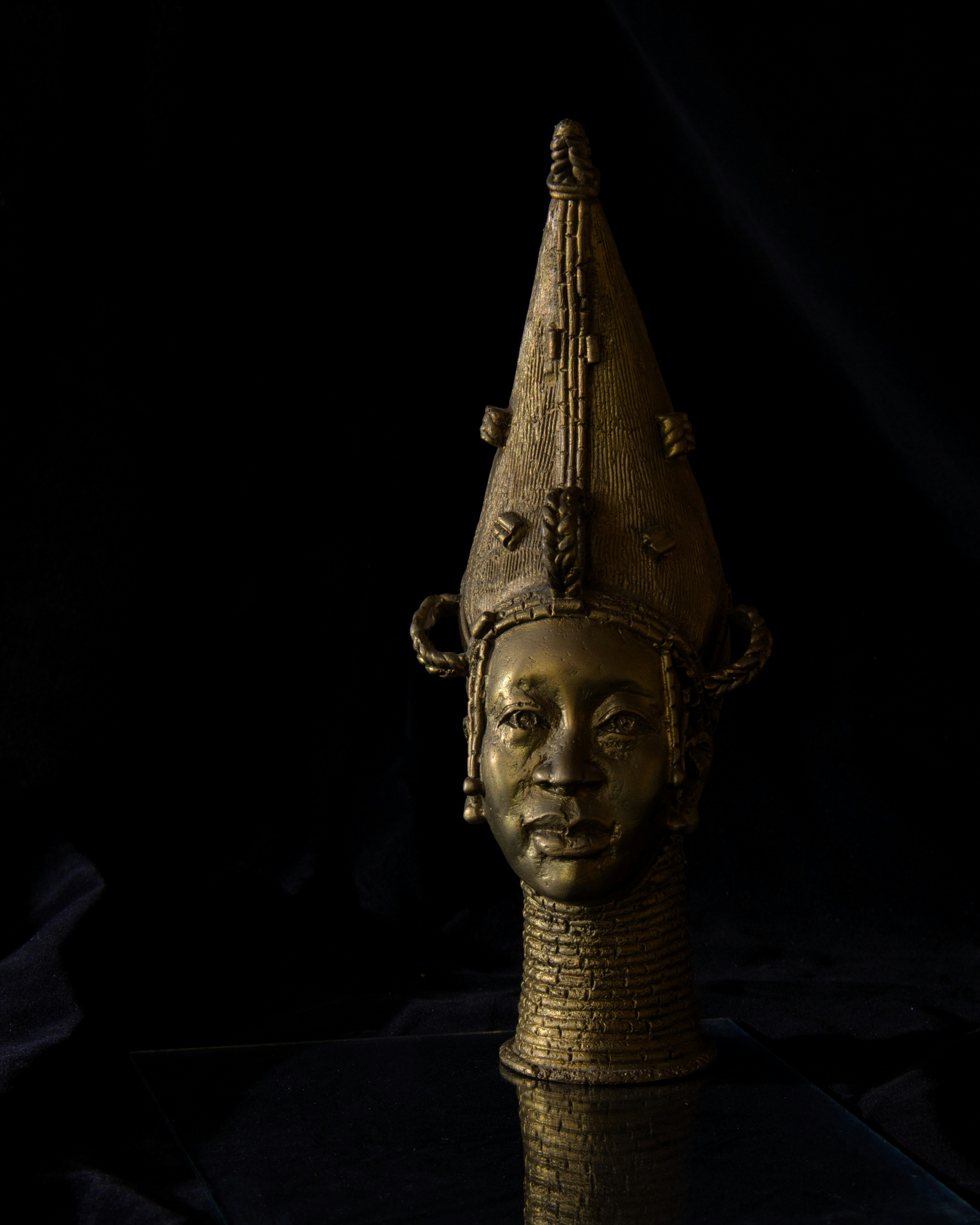
Walk through the African galleries of the British Museum and you will find, among the most technically astonishing objects in the entire building, a wall of brass plaques from a kingdom most visitors have never heard of. They show obas dressed in coral regalia, warriors on horseback, court musicians mid-performance, Portuguese traders in doublets and ruffs. Centuries before some of the museums now displaying them even existed, these were cast by hand in a kingdom that had no need of a writing system, its history was already being recorded in metal, on its own palace walls. Then, in February 1897, that kingdom was invaded, its capital burned, its palace stripped, and thousands of these objects carried off as spoils of war. Empire did this. So did a market in looted heritage that stretched across Europe and America. And a repatriation campaign is still playing out today, more than a century on, in museum boardrooms and Nigerian palace politics alike. This is the story of the Benin Bronzes.
What Are the Benin Bronzes?
“Benin Bronzes” is the collective name for several thousand brass and bronze plaques, commemorative heads, ivory carvings and items of royal regalia produced from around the fifteenth century onward for the royal court of the Kingdom of Benin, in what is now Edo State, Nigeria. Most of the objects, despite the name, are brass rather than true bronze, cast using the lost-wax method by a hereditary guild of metalworkers who worked for the Oba, or king, alone.
The plaques are the most historically important of the group. Benin had no indigenous script, so these reliefs functioned as a visual archive: they recorded the reigns of successive obas, depicted queen mothers, warriors and court officials, and documented the kingdom’s diplomatic and trading contact with Portuguese visitors from the late fifteenth century onward. Commemorative brass heads, meanwhile, were placed on royal ancestral altars and used in ceremonies honouring past rulers. Art historians widely regard the collection as one of the great achievements of pre-colonial African craftsmanship. It remains the primary source used to reconstruct Benin’s internal history before written colonial records began.
The Kingdom Behind the Art
The Kingdom of Benin traces its ruling Oba dynasty to around 1180 CE, when the Edo people replaced an earlier system of rule with a monarchy said to have been founded with the involvement of a prince from Ife. Under Oba Ewuare, who came to the throne in the fifteenth century, the kingdom expanded significantly, and its capital, Benin City, grew into a major urban centre with a formal administration, a standing army and a court hierarchy that governed everything from bronze-casting to ceremonial ritual.
European contact began with the Portuguese in the 1480s, and it brought both wealth and material for the arts: manillas and other imported metal supplied the brass that fed the royal workshops, while trade in pepper, ivory and, controversially, enslaved people connected Benin to the wider Atlantic world for four centuries. Seventeenth-century Dutch visitors described a capital of wide, ordered streets and a palace complex of considerable scale, an account that has become one of the standard reference points for historians assessing Benin’s sophistication before colonial contact. By the time Britain turned its attention fully to the kingdom in the 1890s, Benin was an old, wealthy and highly organised state, not the “primitive” society colonial propaganda later claimed it to be.
The 1897 Punitive Expedition
The event that shattered this kingdom is usually dated precisely: January 1897. A British delegation, led by Acting Consul-General James Robert Phillips, set out for Benin City to press trade demands, despite warnings that the visit clashed with a sacred festival period during which outsiders were traditionally barred from the city. Benin forces ambushed the party; most of its members were killed. Britain’s response was swift and disproportionate. In February 1897, an imperial force of roughly 1,200 men invaded, captured and burned Benin City, destroyed much of the royal palace, and looted its contents wholesale, including the store of brass plaques and thousands of other objects of ceremonial and ritual value, officially recorded as “spoils of war.”
Oba Ovonramwen Nogbaisi, who had reigned since 1888, fled the city but surrendered to British forces in August 1897. He was tried, deposed, and exiled to Calabar, where he died in January 1914; his kingdom was formally annexed into the Niger Coast Protectorate. Historians generally agree that alongside the stated grievance, Britain’s underlying interest lay in securing control of the lucrative palm oil trade and removing an independent West African power from its path. The “punitive” framing sat alongside more calculated colonial ambitions.
Where the Bronzes Ended Up
The looted objects did not stay together, and they did not stay in Britain. Much of the haul was formally auctioned by British authorities to help offset the cost of the expedition, and from there the objects scattered into private collections and museums across Europe and, later, North America. The British Museum received 203 plaques directly from the Foreign Office in 1897 and added further pieces through purchases in the mid-twentieth century; it now holds more than 900 objects from the historic Kingdom of Benin, the largest single UK collection.
It is not, however, the largest collection in the world. The Ethnological Museum in Berlin holds more, and Nigeria’s own National Museum in Lagos ranks third globally by most counts. Sizeable holdings also sit in museums in France, the Netherlands and the United States, including the Smithsonian and the Metropolitan Museum of Art. Estimates of the total number of objects taken in 1897 vary considerably, from roughly 3,000 up to as many as 10,000 pieces of brass, ivory, coral and wood, a range that reflects how widely, and how poorly, the loot was documented as it moved through auction houses and private hands over more than a century.
The Repatriation Movement Today
Calls for the return of the Benin Bronzes are not new, Nigerian voices raised the issue soon after independence, but the campaign has gathered real momentum since the early 2020s, part of a wider reckoning among Western museums with colonial-era collections. Germany moved first and furthest: in July 2022 it agreed to transfer ownership of 1,130 bronzes to Nigeria, with an initial batch of twenty handed over in Abuja that December, involving the Humboldt Forum and museums in Stuttgart, Cologne and Hamburg. The Smithsonian returned 39 bronzes in March 2022, and the Metropolitan Museum transferred two plaques in November 2021. In Britain, the Horniman Museum became the first UK institution to return pieces, in November 2022, and the University of Cambridge transferred ownership of more than 100 objects that December, although as of early 2025 they had yet to be physically shipped to Nigeria. The Netherlands made the largest single transfer directly tied to the 1897 raid in June 2025, handing over 113 bronzes from Leiden’s national museum plus six more from Rotterdam.
The British Museum, holder of the largest UK collection, has not agreed to a permanent return. It points to the British Museum Act 1963, which bars it and other national museums from permanently disposing of collection items except in narrow circumstances, meaning any full transfer would require Parliament to change the law; loans remain legally possible, permanent restitution does not. The museum instead points to its role in the Benin Dialogue Group and to Nigerian-led projects such as the Digital Benin research database and the new Museum of West African Art (MOWAA), which opened in Benin City in November 2024 without a single original bronze on display. Complicating the picture further, outgoing President Muhammadu Buhari declared by decree in March 2023 that returned bronzes belong to the Oba of Benin personally, as royal property, rather than to the Nigerian state, and the current Oba, Ewuare II, has indicated some objects may go into his own palace collection rather than a public museum. Return is happening, unevenly, and with the question of who in Nigeria ultimately holds these treasures still unresolved.
FAQs
Why are the Benin Bronzes in the British Museum? They arrived as spoils of the 1897 punitive expedition. The Foreign Office donated 203 looted plaques to the museum that same year, and further pieces were bought from private collectors in the 1940s and 1950s, building the collection of more than 900 objects the museum holds today.
Will the Benin Bronzes be returned to Nigeria? Some already have been. Germany, the Netherlands, the Smithsonian, the Horniman Museum and others have returned or agreed to return pieces since 2021. The British Museum, which holds the largest UK collection, has not, and is constrained by the British Museum Act 1963 unless Parliament intervenes. Even where objects have gone back, the unresolved question of whether they belong to the Nigerian state or to the Oba’s palace means the story of full, settled return is still being written.
Final Thoughts
The Benin Bronzes were never simply art. They were a kingdom’s memory, cast in metal, because paper was never the medium Benin chose to keep its own record. The 1897 raid did more than strip a palace of treasure. It took the tools an entire society used to remember itself and scattered them across a continent that had just finished conquering it. That is why the repatriation movement matters beyond the walls of any single museum. Every plaque that goes back to Edo State is a fragment of that memory finding its way home, even as Nigeria and Britain continue arguing over who now gets to hold it, display it, and decide what it means. The story is not finished. It is still being negotiated, in Berlin, in London, in Abuja, and in the palace at Benin City, more than a century after the fire.